Software Plan
Proposed
Project:
Dynamic Network Device Mapping System
Clients:
Mr. Ken Swarner
Mr. Eric Crossman
Delivered
By:
SKYNET Software
The
SKYNET Software Team:
Kevin Fealey
Heimdall Imbert
Stephanie Maloney
Trevor March
Andrew Warner
Dynamic Network Device Mapping System (DNDMS)
Software Plan
Table of Contents:
1. System
Definition:
Section 1 – Problem Definition…………………………………………………. 3
Section 2 – System Justification………………………………………………... 3
Section 3 – Goals for the System and the Project………………………………. 3
Section 4 – Constraints on the System and the Project………………………… 3
Section 5 – Functions to be Provided…………………………………………... 3
Section 6 – User Characteristics………………………………………………... 4
Section 7 – Development/Operating/Maintenance Environments………………4
Section 8 – Solution Strategy…………………………………………………… 4
Section 9 – Priorities of System Feature………………………………………... 4
Section 10 – System Acceptance Criteria………………………………………... 5
Section 11 – Sources of Information…………………………………………….. 5
2. Project
Plan:
Section 1 – Life-Cycle Model…………………………………………………... 5
Section 2 – Organizational Structure…………………………………………… 6
Section 3 – Preliminary Staffing and Resource Requirements…………………. 7
Section 4 – Preliminary Development Schedule……………………………….. 8
Section 5 – Project Monitoring and Control Mechanisms……………………… 8
Section 6 – Tools and Techniques to be Used………………………………….. 8
Section 7 – Programming Languages…………………………………………... 9
Section 8 – Testing Requirements……………………………………………… 9
Section 9 – Supporting Documents Required………………………………….. 9
Section 10 – Manner of Demonstration and Delivery……………………………9
Section 11 – Sources of Information…………………………………………….. 9
3. Appendix:
Section 1 – Glossary of Terms………………………………………………….. 9
Section 2 – Team Résumés……………………………………………………...10
System Definition
1.1
Problem Definition:
Our clients, Mr. Ken Swarner & Mr. Eric
Crossman, require software that will allow them to access information from
anywhere in the world. They're going to
use this software to help them maintain hardware throughout the Morrell and
Roger Bacon buildings on the
1.2 System Justification:
The Dynamic Network Device Management System will aid our clients by saving
them time and energy. Both Mr. Swarner
and Mr. Crossman will be able to troubleshoot from anywhere with internet
access and will be able to troubleshoot quicker and in a more efficient
manner. Also, our clients will be able
to locate any stray devices or know if/when new devices have been added to the
network, in which case they may revoke or allow access.
1.3 Goals for the System and on the Project:
We aim to create a manageable web
application that can be accessed via the web from anywhere in the world. The application should have a floor plan (as
accurate as possible) that will give the user an idea of where network devices
are placed.
The software must be both flexible and extensible so that it can adapt to changes in the network configuration.
The goal for the team is to expand and make use of all of the knowledge that we have attained throughout our undergraduate studies and any of our Computer Science related extracurricular activities. We hope to use this as a learning experience and learn how to interact with others in a professional setting. We also desire and surpass the expectations of our clients.
1.4 Constraints on the System and on the
Project:
Our clients have stressed the importance of having a map or floor plan of some sort. This creates a constraint in that we will have to use dynamic images (versus static images) for our application. Because we will be dealing with dynamic images, there is an added constraint of having the software interpret the changes on the fly (as opposed to rewriting or hard coding the current available floor plan).
1.5 Functions to be Provided:
- Web-based application (written
most likely in PHP & JavaScript) will allow our clients to access and
modify information with the touch of a button.
- Graphical representation of the floors and rooms our clients maintain. The room layouts will contain information about
machines in the room.
- A web server (most likely Apache) will be used to host any and all pages and
web application(s).
- A database (most likely MySQL) will store important information from all
network devices. This includes but is
not limited to: MAC Addresses, IP Addresses, Device location, the person/people
the device is registered to, etc.
- A search option will be provided to help our clients look up information
quickly.
1.6
User Characteristics:
The main users of this software will be Ken Swarner
and Eric Crossman. Faculty members
with offices in Roger Bacon or
1.7 Development/Operating/Maintenance
Environments:
The DNDMS will be developed using the Siena College
Software Engineering workstations provided to us. The operation of this
software will be available to Ken Swarner, Eric Crossman, and other faculty
members who have offices in Roger Bacon or
1.8 Solution Strategy:
We will be forming a solution our clients’ needs using a Linear Sequential Model known as The Waterfall Model, which includes the following steps:
· Software Plan: The Team meets with the client and develops an idea of the problem, as well as a means to go about solving it.
· Analysis: Further meetings with the client define the problem more specifically in order to develop the necessary requirements for the project.
· Preliminary Design: Using the requirements specified in the Analysis stage, fundamental design for code is prepared.
· Detailed Design: The basic coding design is altered and improved and machine code is written. This will be done in Spring Semester 2007.
· Acceptance Test: The software is installed and set up for the client. This will also be done in Spring Semester 2007.
1.9 Priorities of System Feature:
The most important feature of this system is its
ability to dynamically generate floor plan images for all floors in Roger Bacon
and
1.10 System Acceptance Criteria:
The system will be able to accomplish the following:
· Give Administrators access to view and change network mapped information from anywhere in the world via a web connection
· Give Instructors the ability to view their own network mapped devices in their own office.
· Dynamically generate a floor plan image with all connected network devices displayed.
· Ability for Administrators to ping any network device shown on the floor plan image.
· Display a toolbox so that Administrators can easily modify the floor maps.
The information used for the System Definition was collected through meetings with our clients, Mr. Ken Swarner and Mr. Eric Crossman. Other sources of information include Dr. Lederman’s class lectures, the Software Engineering class textbook, Software Engineering: A Practitioner’s Approach, 6th Edition, by Roger S. Pressman, as well as Software Plans created by Software Engineering students in the past.
2.1 Life-Cycle Model
Our project is modeled after the Waterfall method.
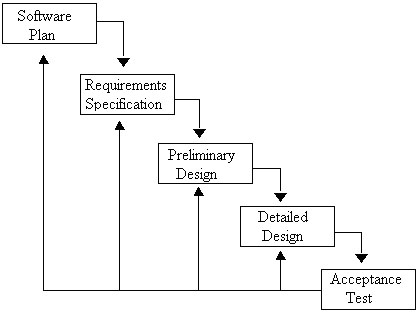
Software
Plan
Defines the problem and establishes goals and requirements to solve that problem.
Requirements
Specification
Team establishes a better understanding of the requirements needed to complete the project
Preliminary
Design
The first steps taken to translate the requirements for the project into software representation.
Detailed Design
Preliminary design code is produced and prepared for testing.
Acceptance
Test
Conclude the Life Cycle Model with final testing and delivering of the product to the client.
SKYNET Software is comprised of the following members:
Name E-mail Phone Number
Fealey, Kevin kw26feal@siena.edu (516) 458-3653
Imbert, Heimdall hb09imbe@siena.edu (917) 596-6974
Maloney, Stephanie ssm8591@siena.edu (518) 859-5199
March, Trevor P. tmarch@siena.edu (518) 813-2353
Warner, Andrew as29warn@siena.edu (518) 598-9364
The team members are organized in the following positions:
Fealey, Kevin - Team Leader
Imbert, Heimdall - Systems Administrator
Maloney, Stephanie - Documentarian
March, Trevor P. - Webmaster
Warner, Andrew – Systems Analyst
The team structure of SKYNET Software is Democratic. All of the decisions will be decided by majority vote. The team leader will be the tiebreaker in the decisions.
The work assignments for each member are as follows:
Team Leader Organizes team and client meetings and
guides the team throughout the semester.
Systems Administrator Maintains user accounts for the team and is responsible for software installation and administration.
Webmaster Creates and maintains the project web page.
Documentarian Responsible for compilation and organization of documentation related to project work.
Systems Analyst Analyzes and manages team data. Handles miscellaneous project related assignments.
2.3 Preliminary Staffing and Resource
Requirements
Our team will need to utilize
various hardware, software, and human resources. The hardware needed includes
computer systems, a Dell computer running Windows XP and a MAC, running OS X.
The software needed includes Dreamweaver, Fireworks, Flash, and Oracle. Our
human resources include Mr. Eric Crossman, Assistant Systems and Operations
Manager, and Mr. Ken Swarner, Systems & Operations manager for the
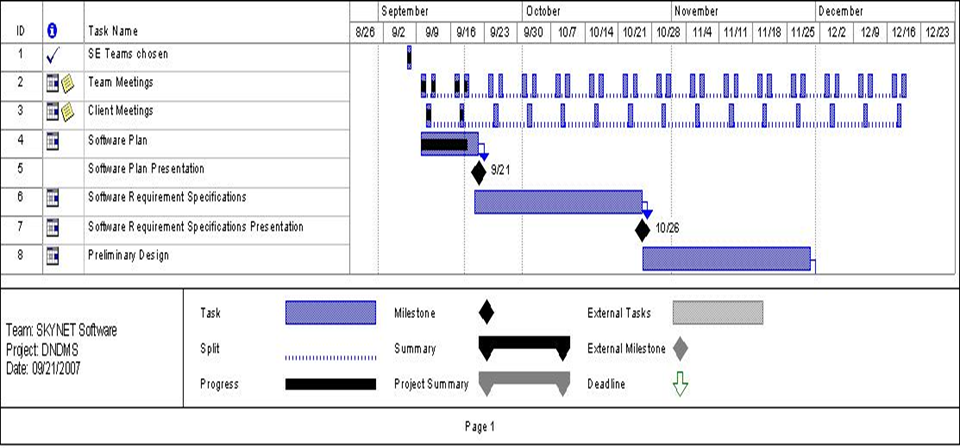
2.4 Preliminary Development Schedule
2.5 Project Monitoring and Control Mechanisms:
In addition to the client meetings taking place at least once weekly, the project team members will also meet as needed to discuss the state of the project and the necessary steps that the team and each individual must take to advance productivity. To ensure that the project is on the proper track and that it corresponds to the needs of the clients, the members of the SKYNET Team will analyze the clients' responses to the team's presentations of the Problem Definition/Project Plan, Software Requirements Specifications and Preliminary Design. Our system will be continuously tested over the course of the development process. If it is discovered by either the project team or the clients that our system is not sufficiently meeting the clients' needs, we will make the necessary actions to correct the problem to keep the client satisfied.
2.6 Tools and Techniques to
be used:
Computers with Microsoft Project will be used for creating timelines. To build the DNDMS, our team will be using Macromedia Dreamweaver, Macromedia Fireworks, and a PHP editor. As the project progresses, any other tools and techniques that the team feels will best fit the clients’ needs, may also be used.
2.7 Programming Languages:
In order to complete the
2.8
Testing Requirements:
There will be extensive testing of the system during the entire development process. Both the project team members and the clients, Mr. Swarner and Mr. Crossman, will partake in the testing.
2.9 Supporting Documents Required:
We will provide supporting documentation to our clients on the following dates:
1. Problem Definition/Project Plan - September 21, 2007
2. Software Requirement Specifications - October 22, 2007
3. Preliminary Design - November 26, 2008
2.10 Manner of Demonstration and Delivery:
Throughout the project development process, we will give several demonstrations. The demonstrations will consist of PowerPoint presentations, speeches, and handouts. The goal of each presentation will be to display what we have accomplished with the project development and to make sure that it corresponds to the clients' goals and expectations. Presentations will occur on the following dates:
1) Problem Definition/Project Plan - September 21, 2007
2) Software
Requirement Specifications -
3) Preliminary
Design -
2.11 Sources of Information:
The information used for the Project Plan will be collected through meetings with our clients, Mr. Ken Swarner and Mr. Eric Crossman. Along with these, information was obtained from Dr. Lederman’s lectures, from the Software Engineering textbook Software Engineering: A Practitioner’s Approach by Roger S. Pressman, as well as Software Plans created by Software Engineering students in the past.
3.1 Glossary
of Terms:
C++: A programming language used for developing object oriented programs.
DNDMS: Dynamic Network Device Mapping System, the name of SKYNET Software’s premiere application.
HTML: Hypertext Markup Language (HTML) is programming language used in the creation of Web pages.
JavaScript: JavaScript is a scripting language developed by Netscape that can interact with HTML source code, enabling Web authors to spice up their sites with dynamic content.
Linear Sequential Model: Sometimes called the classic life cycle or the waterfall model, this model suggests a systematic, sequential approach to software development that begins at the system level and progresses through analysis, design, coding, testing, and support.
PHP: PHP hypertext preprocessor is a widely-used general-purpose scripting language that is especially suited for web development.
MySQL: An open source relational database management system (RDBMS) that uses Structured Query Language (SQL), the most popular language for adding, accessing, and processing data in a database.
Software: Written programs, procedures, or rules and associated documentation pertaining to the operation of a computer system and that are stored in read/write memory.
3.2 Team Resumes: